
As I sped down the busy sidewalk, running over yet another pedestrian with my four-wheeler, I smiled with glee at the swift power over life and death that this vehicle had granted me. Police sirens blared in the background, and a helicopter circled overhead, which I think was a rather extreme reaction in retrospect. After all, I was only twelve years old; I couldn’t be expected to understand all the rules of the road or the fatal consequences of my joyride. Fortunately for the pedestrians, my rampage was brought to an end, though I don’t remember how. Maybe I went down in a hail of gunfire, or maybe the friend who sat next to me had lost his patience and demanded his turn with Grand Theft Auto V, the game we were playing.
Grand Theft Auto V was released in September 2013, and in that same month, an article on the game by pastor John S. Dickerson was published on the Fox News website. The point of Dickerson’s article is relatively straightforward: he seeks to prove that like “other best-selling games today, Grand Theft Auto V trains millions of young Americans to walk into public places and shoot innocent people.” As I look back on Dickerson’s article and the causal link he draws between virtual violence and actual murder, I feel the need to defend myself, seeing as I am a virtual (but not actual) murderer. I have committed a few minor traffic violations in my time, but I don’t think Grand Theft Auto V should be blamed for my vehicular sins. Incidentally, neither does the American Psychological Association, which has repeatedly refuted the idea that video games are training young people for mass violence. Yet many commentators continue to identify video games as the culprit whenever a massacre is perpetrated in a school or supermarket. In 2019, long after Dickerson’s article was published, President Trump said in a public address that to combat mass-shootings Americans “must stop the glorification of violence in our society … this includes the gruesome and grisly videogames that are now commonplace.” Well-reasoned and researched arguments have not been enough to clear the name of video games on their own. Something more is needed.
As my childhood experiences with vehicular manslaughter suggest, I am a lifelong gamer. Like many in my generation, I feel a special connection to video games; they have grown up alongside me, and I feel obliged to defend them the way I would an old friend. Yet, just as I would be concerned for a friend who is uncritical of their destructive habits, I am disturbed by how uncritical video games are of themselves. The gaming industry continues to sell violence as an experience, yet it does not answer questions about the implications of such violence. Instead, gaming continues to rely on academic institutions like the APA to do all the work. Decades of listening to a deadlocked discourse about virtual violence has led me to believe that questions of violence must be explored within video games themselves. Otherwise, the answers will continue to come from people like Dickerson and Trump.
It is here that I need to admit my cheap trick; like many in the media, I have used the unusual gratuity of the violence in Grand Theft Auto V for shock value. When I ran down virtual pedestrians out of a childlike impulse of destruction, I had not even begun to question the complacent violence of video games. Rather, I began to question this as an adult, when I committed far greater violence in NieR Replicant.

The first thing I saw when I started up Replicant were ruins of an unnamed city, as the words “Summer 2053” appeared on the screen amidst what appeared to be falling snow. The camera settled into the ruins of a grocery store and introduced me to the player character, to the person I would become for this story. I was a teenager, a young man, who had to defend my sickly sister from a horde of hostile, shadow-like creatures called Shades. As the onslaught got worse, I made a desperate plea for help to an ominous-looking book, and the screen faded to black. As the darkness dissolved, text informed me that 1,412 years had passed. I lived in a small, medieval-style community, not looking a day older despite the passage of time. And next to me was my young, sickly sister. The world had changed drastically in the millennia and a half since the prologue, but the fundamentals of Replicant remained the same: the game told me to use the sword, the spear, and mysterious magics to save my sister from the Shades who wished to kidnap her. To be honest, all of this seemed to me like an over-the-top, tired escapade of righteous and vengeful violence. But I had already bought the game, and so I focused on the beautiful soundtrack and unique visual style as I went through the motions of a story that I thought I already knew, beat for beat.
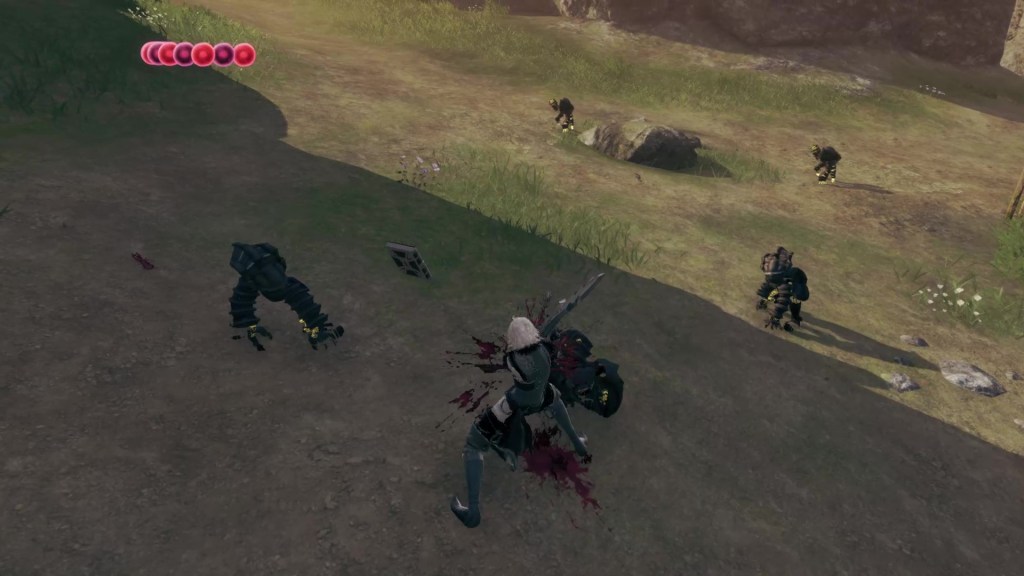
I missed the little hints that Replicant lays out about its true nature; where I thought the game was telling me to push forward, it was asking me to stop and think. For instance, after I sliced and diced my way through a horde of Shades, I would search for items amidst what remained of the Shades that I had killed. The mechanic of looting foes is commonplace in violent video games, and gamers like me have become used to being inundated with loot, the only meaning of which is to provide the player with equipment for future violent encounters. When I found seemingly out-of-context items such as old textbooks or wooden toys near the bodies of smaller-sized Shades, I didn’t question the meaning of such strange items. Rather, I sold them off for in-game currency at the first opportunity, so that I could buy healing items and carry on in the journey (I had to save my sister, after all). There were some things that I wondered about; I didn’t accept everything in the narrative uncritically. One obvious question that I had was about how I survived 1,412 years of global collapse, which I had learned was caused by a long-extinct disease called “White Chlorination Syndrome,” without ageing. I shrugged and continued slaughtering Shades, assuming the reason for my apparent immortality had to do with the magic in the game world, which would of course centre around me and my quest. Unfortunately, I was right.
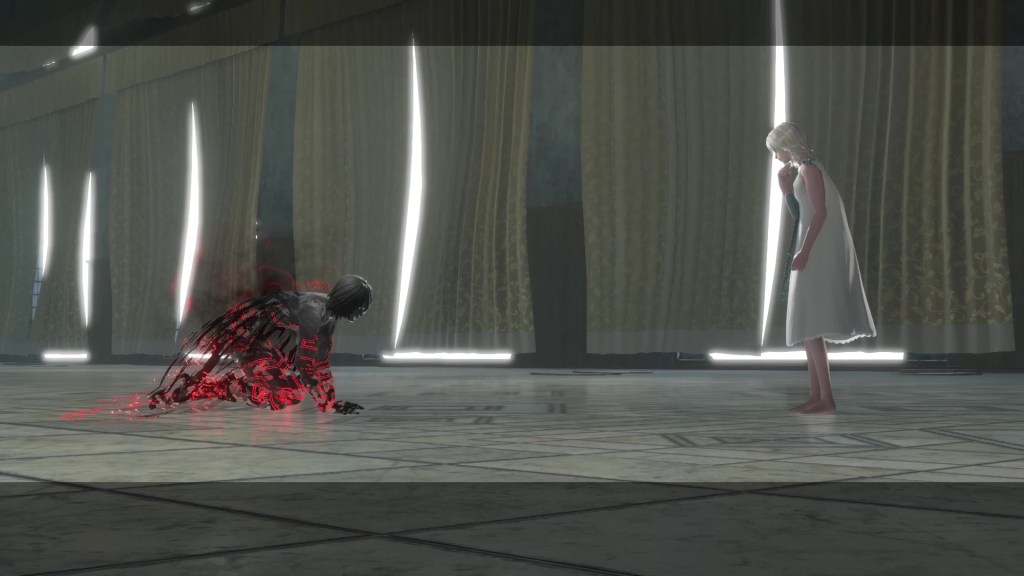
Replicant ended when I killed the Shadowlord, the leader of the Shades who kidnapped my sister. Or was it his sister? The confusion lies in the revelation that was presented to me moments prior: the Shades were humans, or rather their disembodied souls. My sister and I were the eponymous Replicants, homunculi created to reunite with their respective souls after the passing of White Chlorination Syndrome, its effects depicted in the opening “snowfall” of Summer 2053. And in that scene… was me. Or was it actually the Shadowlord? After all, the Shadowlord is the boy I was in the beginning, whose call for help began the separation of souls from bodies. And 1,412 years later, the Shadowlord wanted those bodies back. For himself, but most of all for his sister. Just like me. And now he, along with most other people I encountered throughout the narrative, was dead by my hand. I almost cried when I was presented with what I had done, partly because of the depressing conclusion, but more so because of the gravity of what I had just experienced. In Replicant, I saw a response to the reduction of video games as incitement to violence.
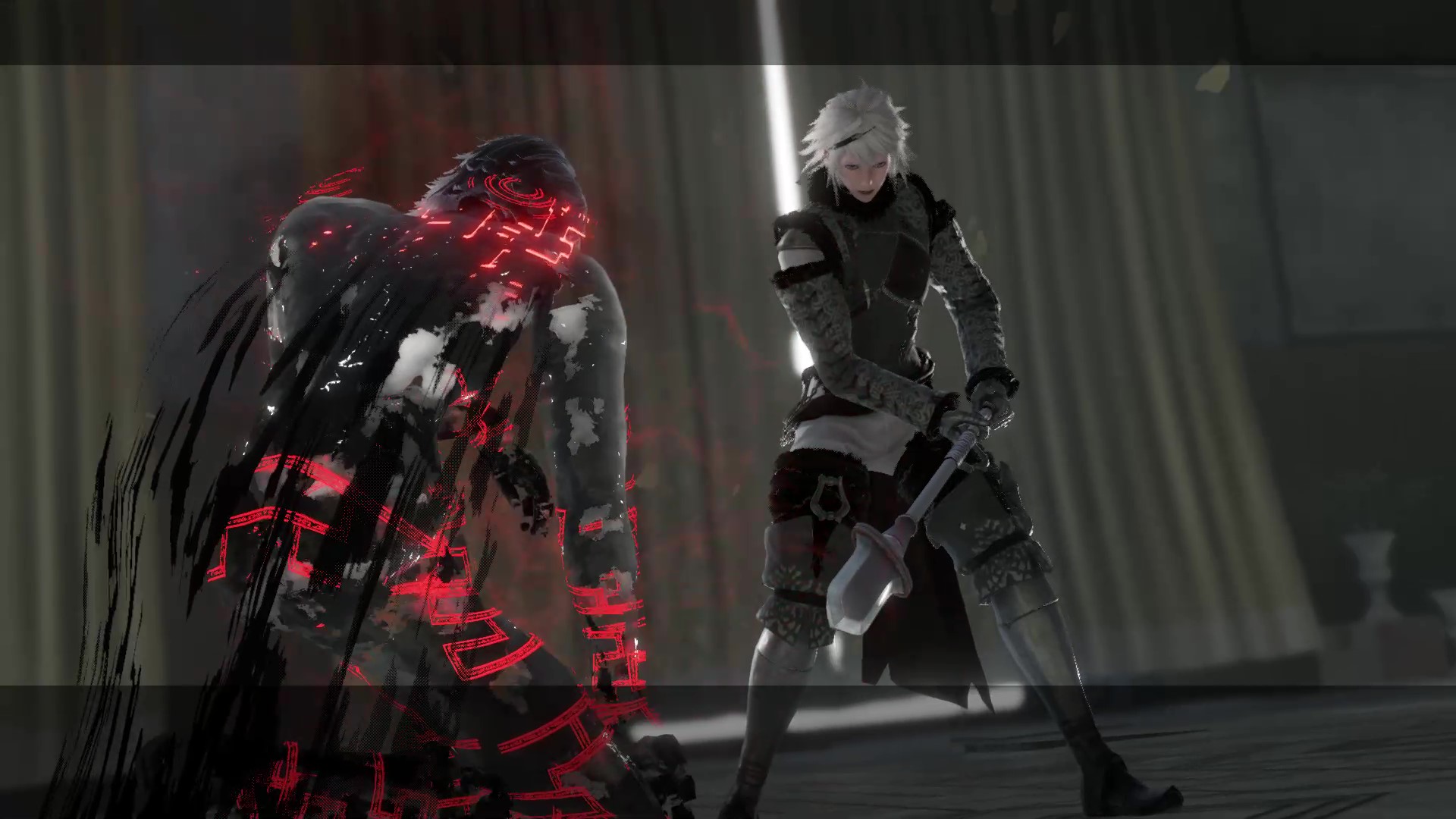
As I said before, I have never slaughtered civilians for fun, and playing a violent video game ten years ago would not push me to do so. It isn’t a desire for violent entertainment that motivates most killers. Rather, when a person takes another’s life, they often do so because think that they are right. Because the killer’s target looks like the enemy that an authority figure, perhaps a President, identified for them. The numbers bear this assertion out: the deadliest mass shooting in the United States killed fifty-eight people, while the deaths resulting from the 2003 invasion of Iraq are estimated at close to half a million. When I killed thousands of virtual people in Replicant, picking up their old textbooks and toys along the way, it wasn’t out of a desire for wanton destruction. I did so because I genuinely thought it was right, because the Shades lived up to the ideas constructed for me about how an enemy should look and act. Replicant rejects the assumption that all video games are gleefully violent and uses that preconception to weave a tale about the dangers of dehumanization and the importance of empathy. In doing so, the game flips the script on moral crusaders who decry video game violence yet eagerly accept violence in its “proper” spaces, such as foreign battlefields and urban slums.
Replicant is far from a perfect game. Among its many flaws is cliched dialogue, which has a triple helping of anime cheese. Its runtime is padded, with dull side-quests and tedious requirements to achieve the full ending, and the combat isn’t interesting enough to sustain multiple playthroughs in and of itself. Yet the fact that Replicant manages to be so meaningful despite these serious flaws speaks to its worth. Gaming is a young medium that is already faced with myriad questions and accusations. The story that I played in Replicant has provided one answer, and I hope to play more stories that give their own answers as well.

 The Third Medium
Leave a comment