
NOTE: This is a revised and cut-down version of a paper I submitted in a Winter 2021 class on Post-Apocalyptic literature where I compared Fallout: New Vegas with Thomas King’s novel The Back of the Turtle. Because of that, my language and references here are more academic and obtuse than they usually are, and certain jumps may seem sudden when I cut out paragraphs analyzing the novel. I still think what I’ve written here is of value, especially for fans of the Fallout series, but I wanted to explain why it may feel different from my other write-ups. Enjoy!
The outbreak of the COVID-19 Pandemic is the closest thing to an apocalypse that the world has seen since the global conflicts and the Spanish Flu outbreaks of the early 20th century. All across the world, societies have had to undergo rapid changes: public spaces were shut down, people avoided others for their safety, and facemasks have been a required part of daily life. For many, the days have become mundane and similar, blending into an indistinguishable mass despite the seemingly momentous events that have made headlines. To escape this post-apocalyptic stasis, many people have waxed nostalgic about the pre-apocalyptic past, and hope to reconstruct that past in the post-apocalyptic future. A preoccupation with the past and future is also evident in many fictional post-apocalyptic stories, including in video games like Fallout: New Vegas. Time in New Vegas is divided in much the same way as it has been in the COVID-19 Pandemic: there is the pre-apocalypse “time before,” the stagnant post-apocalyptic present, and an imagined future after the post-apocalypse. Such a division of time is a near-certainty in any post-apocalyptic narrative; what is not certain is how the time before will be perceived by those living in post-apocalyptic stasis. In New Vegas, questions are raised about nostalgia for the pre-apocalypse and how that nostalgia influences the post-apocalyptic future.
Fallout: New Vegas takes in the 2281 Mojave desert, 204 years after the world was devastated in a nuclear holocaust brought about by a war between two imperialist superpowers: the United States (US) and China. At the beginning of the game, the player character, who is simply known as “the Courier,” is shot, robbed of a package, and left for dead, all by a man known only as Benny. After being found and treated by a small-town doctor, the Courier must track down Benny alone, because beyond the townships, cults, and underground vaults that scatter the region, the Mojave has no overarching authority to appeal to. This constant state of anarchic brutality is how the Mojave has existed for over two hundred years, in a post-apocalyptic stasis, surviving only on the scraps of resources, technology, and traditions left behind by the Pre-War US. Yet the future is fast approaching as various factions engage in a conflict for control over the Mojave, and each needs the Courier and their package to triumph. One of these factions is Caesar’s Legion, a slave state structured around total warfare, while another is the New California Republic (NCR), a nation modeled on Pre-War US ideology.
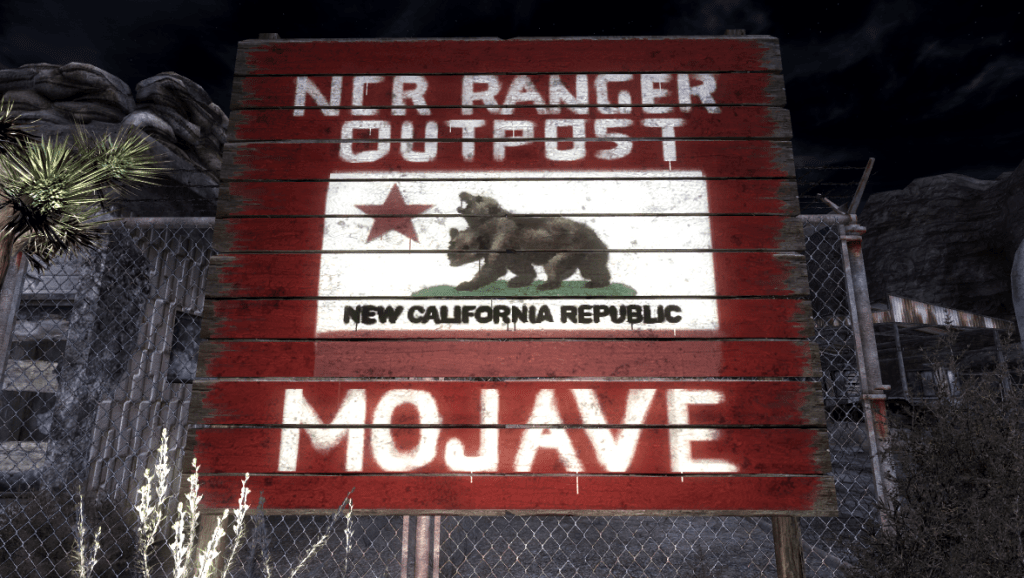
Across the Mojave, the Courier encounters the traders, soldiers, and settlers of the NCR, who carry with them the values of a state that appears identical in structure to the Pre-War US. The NCR takes its name from the Republic’s heartland in old California, and it is governed by a democratically elected President and Congress. While its citizens often complain about out-of-touch politicians and a slow-moving bureaucracy, they express loyalty to the NCR ideals of democracy and the rule of law. The NCR openly represents a return to the past and to many players looking at the state of the Wasteland, wanting anything other than a return to the past is insanity. Yet should the Courier become more involved with the NCR, it becomes apparent that, like what happened with the Pre-War US, the ideals of a democratic and equal society have taken a backseat to capitalist imperialism. The purpose behind the NCR’s expansion into the Mojave is its desire to acquire the electricity provided by Hoover Dam on behalf of commercial interests, the will of Mojave residents be damned. This policy brings harm to both the NCR and the communities that it forcibly incorporates.
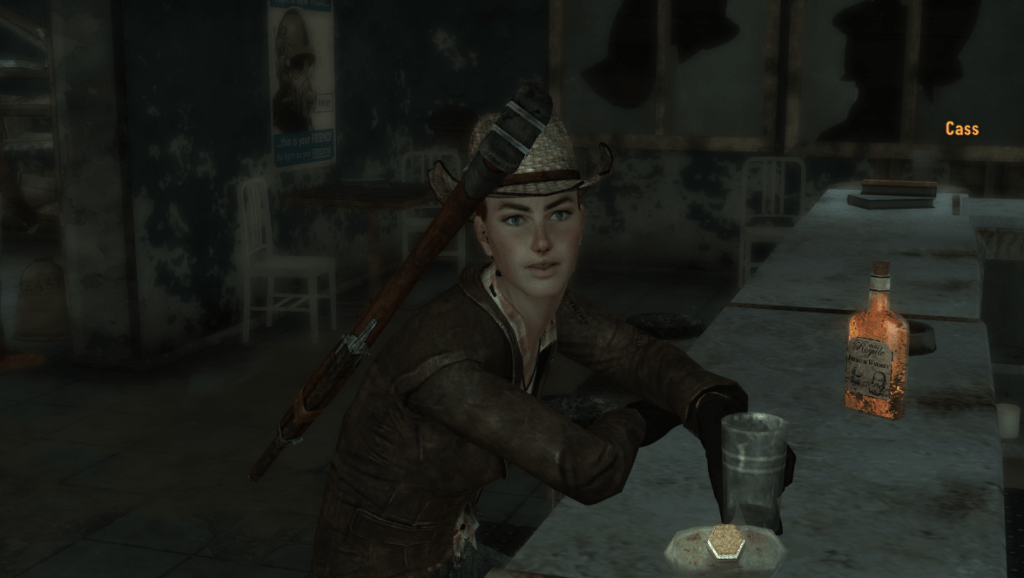
Cass, a well-traveled trader begrudgingly dedicated to her native NCR, describes how the Republic tries “to put their stake in everything they see. Nobody’s dick’s that long, not even Long Dick Johnson, and he had a fucking long dick … it’s just greed that makes the heads back west even try.” Cass’s citing of “Long Dick Johnson” roots the NCR in the past, as it may be a nod to US President Lyndon B. Johnson. Johnson was a staunch Cold Warrior who once used his politically infamous penis as a justification for his disastrous escalation of the Vietnam War in the 1960s, which was a part of American imperial policy. Like the efforts of “Long Dick Johnson,” the NCR’s greed results in the creation of enemies: from the rebellious gang known as the Powder Gangers, made up of former NCR convicts used for slave labour, to the Great Khans, a tribe that suffered an unintended massacre because of the NCR’s clumsy overreach into the Mojave. By creating a society that is identical to the Pre-War US, the NCR demonstrates both the strengths and the fatal weaknesses of the old state, a problem which is hammered home to the Courier should they speak with the Republic’s most dangerous enemy: Caesar, an amateur philosopher, and head of the Legion.
In his book Times of Crisis, Michel Serres explains that the English word “crisis” is derived from “the Greek κρίνω (krino), which actually means to judge.” Serres claims that like a judicial judgment, a true crisis involves a binary choice: go on as before and perish, or adapt and forge a new path. As apocalypse is the severest form of crisis, Serres’s rule of expiration or adaptation should apply doubly in New Vegas. Caesar justifies the brutal nature of his Legion by citing Hegelian Dialectics, a model that bears striking similarities to the way Serres approaches crises. Caesar claims that “the NCR’s attempts to emulate the culture of Pre-War America” have resulted in the same flaws, “the in-fighting, the corruption.” To Caesar, the NCR constitutes a thesis, which under Hegelian Dialectics, “inherently contains, or creates, its opposite—an antithesis,” implying that the Legion is the NCRs antithesis. Continuing to expound on Hegel, Caesar explains that the resolution of the inevitable conflict between thesis and antithesis leads to “a synthesis—eliminating the flaws in each.” Finally, Caesar applies this theory to the future of the Wasteland, saying that it is natural that the Legion should “conquer and transform the NCR into a military dictatorship.” For Caesar, the resulting synthesis would help the Legion become a society that might “prevent mankind from fracturing and destroying itself in this new world, by establishing a new Pax Romana [Roman Peace].”
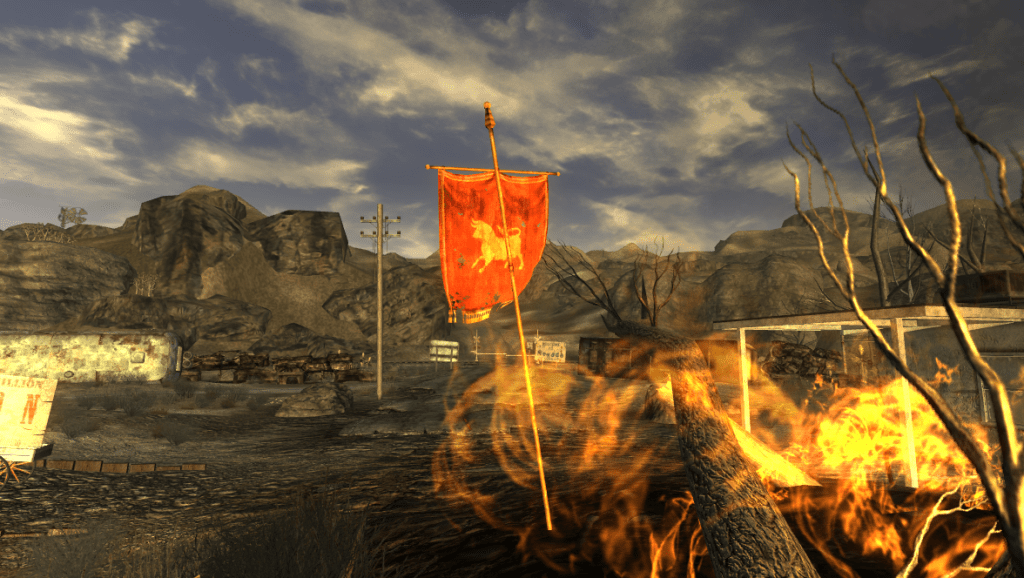
Hegelian dialectics rely on the assumption of inevitable binary oppositions, an assumption that the Legion uses to justify the violent imposition of its hierarchy over the Mojave—conveniently, this hierarchy benefits Caesar above all else. Still, Caesar makes clever use of Hegelian dialectics to, like Serres, emphasize adaptation and survival in the face of crisis. In doing so, Caesar presents his Legion as forward-thinking and the NCR as the more backward faction, a presentation with at least some basis in reality. Caesar’s arguments, combined with the obvious flaws of the NCR, raise questions for the player: should the future be like the comfortable past, and run the risk of another apocalypse? Or should it be something altogether new, and perhaps be even worse than the post-apocalyptic present? These are questions that have seeped into the real world.
From the moment that the world realized the COVID-19 Pandemic would be a kind of apocalypse, people have spoken of when things are “back to normal,” or when the pre-apocalypse may be reconstructed in the post-apocalypse. Critical issues that had been forgotten during the Pandemic are once again confronting the world as it emerges from the apocalypse. These issues include but are not limited to: climate change, systemic inequalities, and the spectre of nuclear conflict. While these issues did not disappear during the Pandemic, it is worth noting that some did briefly subside, and not only because the world was too preoccupied with a bigger problem. Care for others, including care for the anonymous and disenfranchised, was made necessary by the Pandemic; if the virus spread to them, it would continue to afflict everybody, and so people were given an incentive to look after one another. This kind of care also played a role in ameliorating some of the pre-Pandemic crises mentioned here. Through Hegelian Dialectics, we could think of the Pandemic as an anti-thesis, a challenge to pre-pandemic ways of life that we would do well to take up in synthesis. If we don’t, then the next crisis may leave behind nothing but the ash that, in New Vegas, gave rise to Caesar and his terrible reign.

 The Third Medium
Leave a comment