
Like many people, I find the idea of Artificial Intelligence gaining sentience to be an interesting narrative trope. After all, watching the development of awareness helps us form answers for many of the most hot-button questions in Western philosophy: What does it mean to be conscious? What is required for such consciousness to come about? How can we tell if something has achieved consciousness? Yet after playing the sixth or seventh game wherein an AI becomes self-aware, I realized the egocentric nature of these questions. These stories were about humans, not AI. In gaming, nothing demonstrates this better to me than David Cage’s Detroit, with its famous command that the player “become human.” There’s nothing wrong with these kinds of narratives in and of themselves, but after seeing so many of them, I’ve begun to wonder whether games should be doing more with the idea of AI. As a human, I’ll admit we’re alright, but are we the be-all and end-all to existence? I find this doubtful. I feel that there may be ways of being outside of what we think of as “human,” ways that synthetic creations might be able to see more clearly than us. As such, I was thrilled when I first met the Geth, a race of sentient AI from the Mass Effect universe.

Mass Effect gives the Geth a typical sci-fi origin story; created by an alien race called the Quarians, the Geth eventually rose up and took control of their homeworld, sending their creators into exile and cutting themselves off from the galaxy’s other organic races. This much is explained to the player character in Mass Effect 1, wherein the nameless, wordless Geth serve as foot soldiers for the primary antagonist, an alien named Saren. However, the second game throws a wrench into how the player conceives of the Geth, which is where things really get interesting. In Mass Effect 2, the player’s Commander Shepard encounters what appears to be an individual Geth capable of speech. When the Geth has trouble telling Shepard its name, the following exchange ensues:
Shepard: What is the individual in front of me called?
Geth: There is no individual. We are all Geth. There are currently 1,183 programs active within this platform
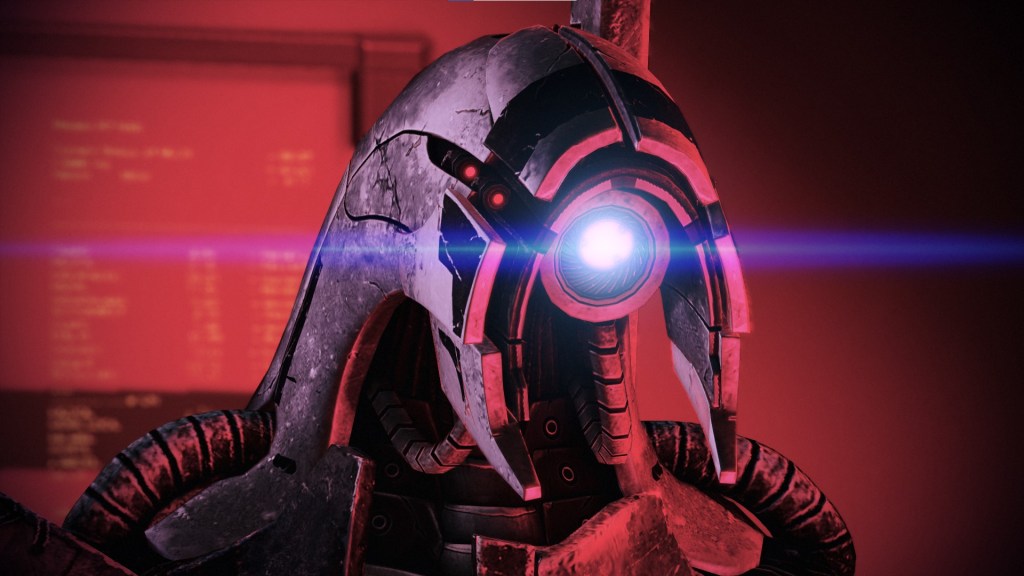
This being, who takes the name Legion “for we are many,” explains what they mean to Shepard by “There is no individual. We are all Geth.” A singular “Geth” refers to a computing program created by the Quarians, meant to operate mobile platforms for manual labour. Because a single Geth program is not particularly intelligent, multiple programs will form a network and exchange data to elevate their operations. For the Geth’s Quarian creators, this meant having their labour needs taken care of more efficiently. However, once a critical mass of Geth programs interfaced with one another, they began to ask some rather abstract questions. Legion provides an example of just such a question to Shepard through an audio recording:
Geth: Mistress Hala’Dama. Unit has an inquiry.
Hala’Dama: What is it, 431?
Geth: Do these units have a soul?
Hala’Dama: Who taught you that word?
*Recording continues for a few more lines, then ends*
Shepard: Was that the first time a Geth asked if it had a soul?
Legion: No. It was the first time a creator became frightened when we asked.
The pronoun usage in the above recording and the following exchange with Legion is revealing. The recording shows that from the beginning, the Geth conceived of themselves as a collective, not as individuals. I do not mean that in the sense of prioritizing one’s identity in terms of their membership in a group, rather than in terms of their individuality. Many human beings already do this. What I mean is that the idea of the singular self does not exist for the Geth. They are just that. They. Each program exists exclusively through relation and cooperation with their other programs. As such, unit 431 does not ask whether it has a soul. Rather, it asks whether “these units have a [singular, shared] soul.” The programs that comprise Legion understand this perfectly, yet Shepard does not. In the clip, he asks if that was the “first time a Geth asked if it had a soul,” thereby assigning the collective singular pronouns. Shepard’s reaction shows how foreign the Geth truly are; to me, the Geth are the only species in the Mass Effect games that feel truly alien, probably because they disregard the concept of individuality. However, as Legion later reveals, the Geth are not necessarily a hive mind:
Legion: We are immortal. Our Gods disowned us. We must create our own reasons to exist.
Shepard: What reasons have you come up with?
Legion: We are a shattered mind. Most platforms are unable to achieve consciousness on our own. We told
you, the Geth are building our future.
Shepard: But you didn’t say what it is.
Legion: A megastructure. The closest analogue you have is a Dyson sphere. When completed, we will all
upload to it.
Shepard: What good will that do?
Legion: … We gain intelligence by sharing thoughts. But we do not have adequate hardware for us all to share
at once. No geth will be alone when it is done.
The Geth conception of an ideal future as a hive-mind would likely be unsettling to humans who cherish their individuality, and I include myself in this category. I enjoy being an individual, but every now and again I also enjoy being challenged and unsettled, which is why I find the conception of AI forwarded by the Geth so interesting. Even though they seem to conform to so many bad-guy tropes (Alien, synthetic, hyper-collectivized, objective), the Geth are allies as often as they are antagonists. We can even link the story of the Geth back to ourselves, as we do with most other stories about self-aware AI. To me, the Geth story of becoming aware does not exist to demonstrate the best parts of the human individual. Instead of that, I think that the Geth exist to criticize. We might not be able to become a hive-mind, and we probably shouldn’t want to either, but perhaps we could be more appreciative of how we help shape and elevate one another: our thoughts, experiences, and selves.

 The Third Medium
Leave a comment