
So far, every game I’ve discussed on this blog features a large-scale conflict that encompasses the fate of entire nations, worlds, or even galaxies. While most of those games feature strong characters and engaging subplots, these things are almost always subordinated to the larger, ostensibly more important drama. Gaming’s fixation on over-the-top spectacle can be exhausting, so I was excited when I discovered OMORI, a psychological horror game with RPG elements that focuses exclusively on the emotional journeys of a few characters. The protagonist of OMORI is an adolescent shut-in named Sunny, and while some segments of the game may take place in the “real world,” Sunny prefers to exist in an elaborate fictional realm called “headspace.” There, Sunny spends time with imaginary versions of the real-life friends that he had before cutting himself off from reality, something that the game suggests Sunny did to avoid dealing with the suicide of his older sister, Mari. Over a few days, the player accompanies Sunny as he either confronts his trauma or flees deeper into delusion. This deeply personal premise drew in many players, including me, and seems to have paid off well; 98% of the over 30,000 user reviews for OMORI on Steam are positive. Yet while I liked OMORI, and continue to be intrigued by it, I believe the game should serve more as a warning than an inspiration to the creators who might draw from it. Before I go any further, I’d like to thank Tumblr user PeppermintBee for her own write-ups about OMORI, seeing as it was her scathing critique of the game’s twist ending which helped me make sense of my own ideas.

OMORI invests most of its energy into developing relationships (real and imagined) within Sunny’s group of friends. In headspace, that group consists of five members. The younger of those members include Aubrey, a bright and cheerful girl with a thinly veiled crush on Sunny, Kel, an energetic rascal who never fails to bring out Aubrey’s more aggressive tendencies, and Sunny’s best friend Basil, shyer than the others but with creative energy that he applies from behind the scenes. The group is watched over by two teens; Hero, Kel’s stalwart older brother who is also Mari’s boyfriend, and the caring, talented Mari herself, whose perfectionism seems her only flaw. In headspace, this group gets up to all kinds of wacky adventures, which invariably end when memories of his sister’s death encroach on Sunny’s delusions.
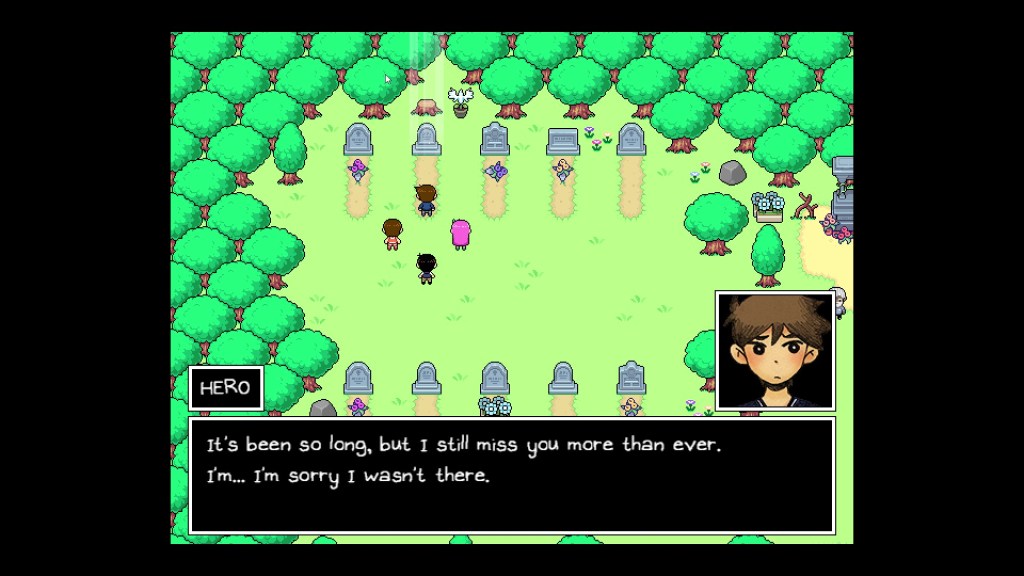
Should the player force Sunny to leave his home during the daytime segments, they will learn how the years since Mari’s death have affected each member of the now-dissolved friend group. While the resilient Kel has managed to cope well enough with the support of his family, Aubrey fares much worse; her home is dysfunctional, and she feels abandoned by Mari, who she viewed as a much-needed older sister. For his part, Hero consistently wonders at his inability to see the despair that must have led to his girlfriend’s suicide, while Basil seems to have followed Sunny’s lead and cut himself off from others altogether. The headspace version of the friend group is an idealization of their reality before Mari’s death, which is contrasted in the game’s day/night cycle with the real, traumatized versions of the characters. I think it’s worth noting that, even in the dreamworld segments where the game can escape the physical confines of reality, Sunny and his friends feel like the limited and vulnerable children that they are. I felt protective of these characters, and whenever they expressed their desire to return to the way things were before, I wanted to help them get there. Of course, I know it is not possible to turn back the clock or resurrect a dead loved one, but I continued playing in the hopes of helping Sunny and his friends overcome the trauma of Mari’s “suicide.” Only, as is revealed in the game’s main twist, Mari’s death wasn’t a suicide at all.
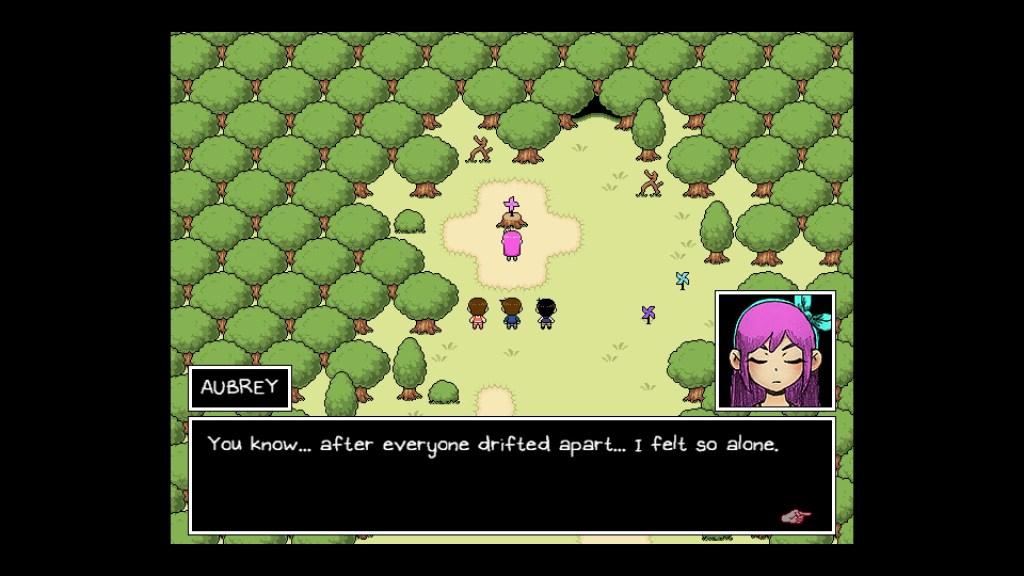
As OMORI approaches its conclusion, the game reveals that in a spat between siblings, Sunny pushed Mari down a flight of stairs, accidentally killing her in a moment of careless anger. Sunny and Basil then hanged Mari from a backyard tree to make her death seem like a suicide. As PeppermintBee points out, this twist was not necessary for the game’s narrative to make sense or have gravity, because survivor’s guilt is a very real and relatable emotion. After all, a compelling narrative about overcoming that kind of trauma carries the first two-thirds of the game. Yet OMORI abandons its setup for a different kind of story, one that it fails to present in a satisfying and tasteful way. In what the game calls its “good” ending, Sunny finally confesses to his friends, with the game cutting off right before they can react. While there is nothing wrong with the action of Sunny confessing (on the contrary, it is what he should do), the issue is how the game builds up to and depicts his confession.
Rather than framing Sunny’s confession as the first step in a journey of accountability, and a journey of healing for his victims, OMORI emphasizes the fact that Sunny confesses in order to be forgiven. As PeppermintBee writes, the “ending headspace segments are focused on assuring Sunny that his friends will support/forgive him no matter what.” Sunny’s imaginary versions of his friends give him encouraging messages, the most telling of these messages coming from his co-conspirator Basil, who says that “Aubrey, Kel, and Hero are good friends. You have to trust that they’ll forgive us.” The game plays on the desire of its characters (and many of its players) to go back to the way things were before, and it presents Sunny’s confession as his attempt to do that. Yet that kind of presentation is deeply narcissistic; OMORI takes pains to explore the trauma of Sunny’s friends, trauma that he caused them on every level. Recall that Aubrey and Hero’s grief is presented as being worsened/prolonged by their belief that Mari took her own life, something that Sunny manipulated them into believing. Not only does Sunny owe his friends the truth, but his revelations could actually hold the key to helping them move on. While Sunny does provide the truth in the “good ending,” he does not do so out of concern for his friends, but rather out of concern for himself. Though OMORI tries to present this type of confession as, well, “good,” I was unable to find any sense of catharsis in this ending; I was drawn in by OMORI’s exploration of the darkly personal, but I was disturbed by its narcissistic conclusion.

Despite it all, I’m glad that this game has gotten lots of visibility and praise. There are so many excellent things in OMORI, not least how it delves into uncomfortable and intimate spaces where few games are willing to go. I only hope that future developers can tread that territory more carefully and tastefully than OMORI does.

 The Third Medium
Leave a comment