
Yup, this one’s a game I never shut up about—but this time, it wasn’t my idea, I swear! You see, I took the Gothic literautre course I talked about in the introduction with my friend Lam, whose experience with gaming and narrative theory dwarfs my own. After one of our classes, Lam messaged me asking whether we could interpret DAO as a Gothic videogame. Aesthetically speaking, DAO screams Gothic, but that doesn’t mean much in and of itself; Gothic architecture was popular throughout the mid to late medieval period, and Thedas is a dark fantasy setting based off medieval Europe. So, of course there are creepy castles and scary monsters coming out of the woodwork (or stonework). If Gothic was merely an aesthetic, every dark fantasy RPG would be classified as Gothic. But Gothic is more than an aesthetic. As I said in the series introduction, we’re dealing with tropes too, and Lam identified a key Gothic trope at the heart of DAO: the return of the repressed.
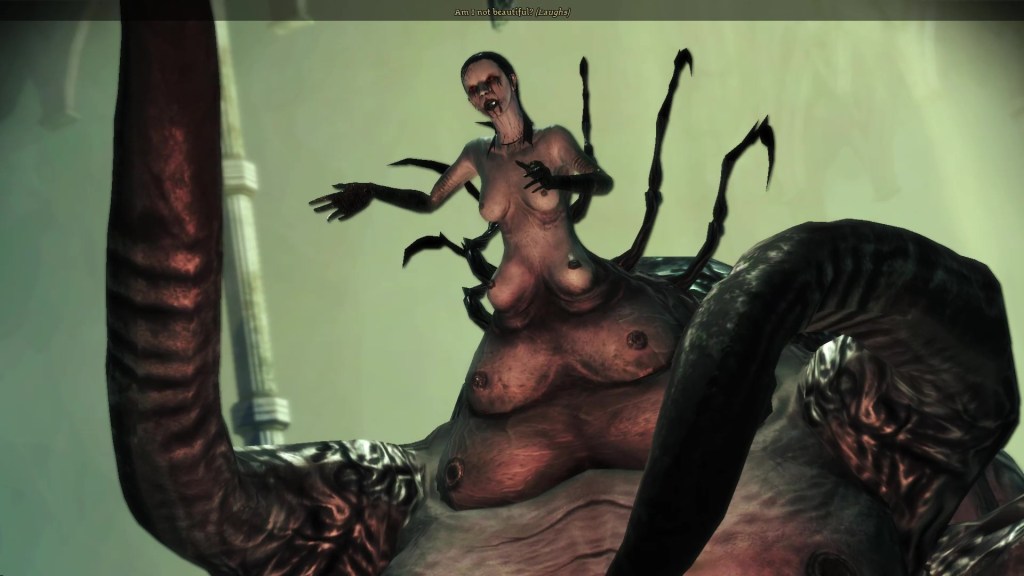
The return of the repressed has its roots in psychoanalysis. Basically, Freud (whoops, wrong link) theorized that unconscious material was indestructible, meaning it never really goes away. Therefore, if a memory or desire or whatever disturbs a person so much that they need to rid themselves of it, their only option is to repress that thing and shove it into the unconscious. There, the thing stews and simmers and inevitably boils over, showing itself in Freudian slips, behavioural outbursts, etc. This return of the repressed is all over Gothic literature. For example, in “The Fall of the House of Usher,” it first seems like Madeline Usher rises from the grave as a supernatural monster. Yet looking at the story in detail reveals that she emerged from her tomb after her brother Roderick buried her alive to repress their incestuous relationship. In Gothic narratives, the repressed always returns, physically or mentally (usually both). In DAO, the Darkspawn horde is the main threat and an instance of the return of the repressed. The story is this: Thedas was once ruled by a cabal of mages that performed a ritual to enter the heart of heaven in search of unlimited power. For their transgression, the Maker exposed the sinful nature of the mages by expelling them back into Thedas as monstrous and mindlessly violent beings, the first of the Darkspawn. The Darkspawn reproduce like rabbits, spread a wasting disease called the Taint (gross, I know), and periodically menace the other races with apocalyptic campaigns of destruction called Blights. That last bit is the most important. While humans, dwarves, and elves push the Darkspawn underground, they always return, reminding the inhabitants of Thedas of their past sin.
So, does all that mean we can safely classify DAO as a Gothic game? Not exactly. Let’s go back to literature for a second; in “The Fall of the House of Usher” and most other Gothic texts, the thing that characters repress can’t just be beat up and put back in its box, because you can’t beat up a sin or a memory. They’re concepts. Sure, the repressed might manifest in physical form, but it remains in the pyshce even if you destroy that manifestation. Roderick would still be haunted by his incest even if his sister stayed in her tomb—and that’s what’s so scary about the whole thing. The repressed cannot be destroyed. Characters in Gothic stories are either consumed and destroyed by what they repress, or they repent, change, and learn to live with what they were once ashamed of. None of those things happen in DAO.
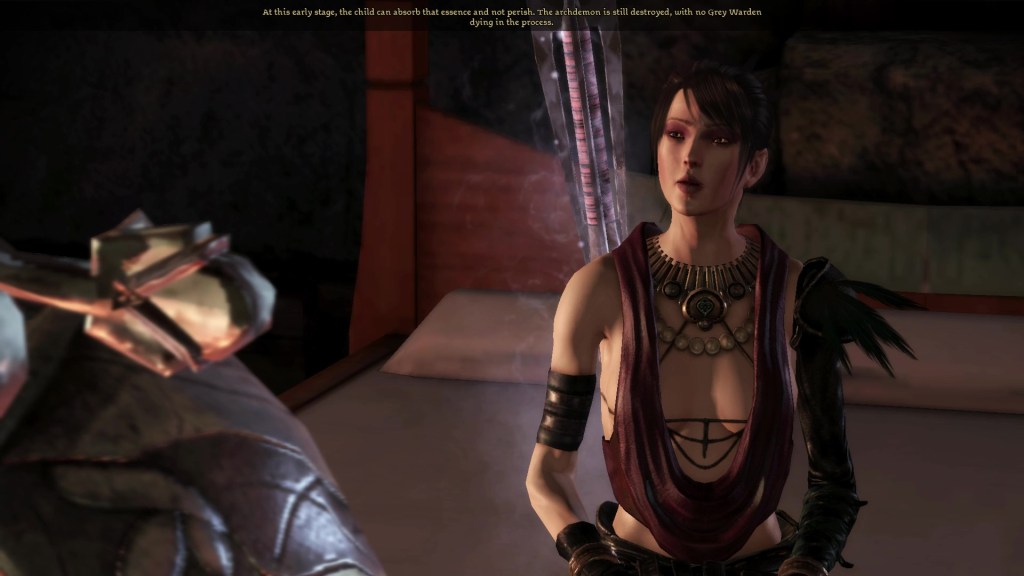
Regardless of the player’s decisions, the Blight is stopped and the Darkspawn are beaten underground to stew for another couple hundred years. The “sin” that the races of Thedas are repressing is separated from them and put into these other entities that are corporeal, monstrous, and—unlike Freud’s indestructible unconscious—very killable. It’s true that the Grey Warden protagonist of DAO has to take the Darkspawn Taint into themselves to kill the Archdemon and end the Blight. Yet that isn’t a Gothic blurring of boundaries (“who’s the real monster here?”) so much as it’s a kind of Christian trope of messianic sacrifice; absorbing the taint and killing the Archdemon means the Warden’s righteous death. There is a way for the Warden to avoid this fate, but it’s not to somehow come to terms with the Darkspawn and the evil side of humanity they embody. Rather, a Warden can just have sex with an attractive and witty witch lady—no curses or catches involved—in a slightly convoluted ritual to escape their grim fate. No matter which way you slice it, the Warden is a classic video game protagonist in that they can get out of pretty much any problem they face by fighting or fucking. A Gothic protagonist can’t have that level of power. If they did, something like the return of the repressed could never frighten that character, unsettle the reader/player, and force the kind of development that makes Gothic tales compelling.
To be fair, none of what I’ve said is a criticism of DAO; nobody says it has to be Gothic. While the Darkspawn threat would probably be more interesting if it required the player to confront ideas of guilt, ambition, and monstrosity within human nature (well, human, dwarven, and elven, but you get the point), the game has plenty of other selling points. The Darkspawn are merely a backdrop to the incredible roleplaying system, stellar supporting cast, and expertly interwoven subplots that make DAO worthwhile. Yet Lam wasn’t wrong either— the Darkspawn are a return of the repressed. It’s just that DAO handles this trope in a dull and decidedly non-Gothic way: “fighting and fucking.” Of course, there’s lots of fighting and fucking in traditional Gothic narratives, but that usually ends up being the source of the problem, not the solution. Hmm… a game where violence ISN’T the answer…

 The Third Medium
Leave a comment