
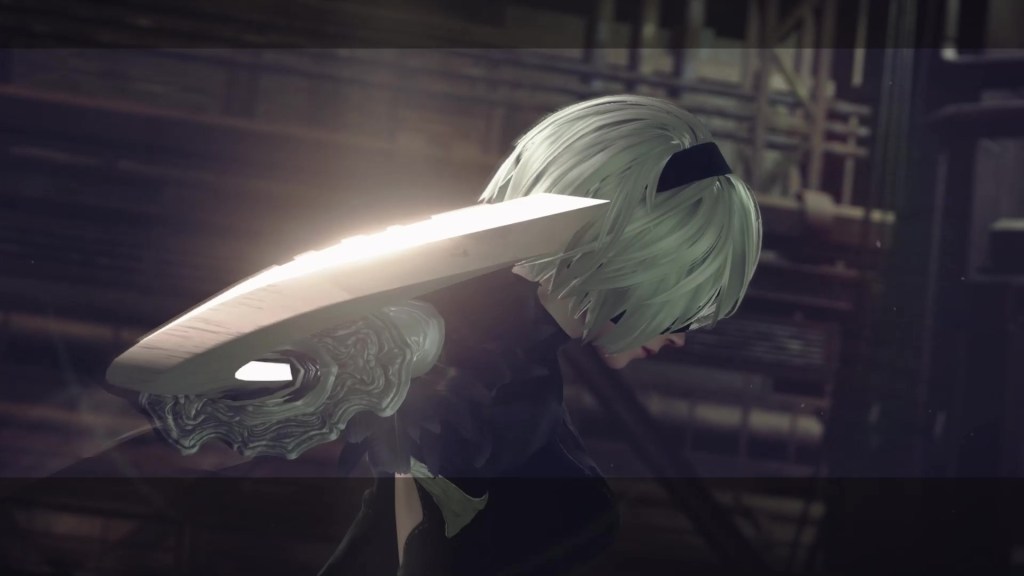
Exciting news! I’ve got a new batch of stuff to share with you over the next couple months, starting with an article I recently published on NieR: Automata in Press Start. Press Start is an open access academic journal, which means you’re free to check out the article whenever you’d like at no cost. The style and tone of this piece are a bit more formal than most of my posts here, but at its core, it’s the exact sort of thing this blog was meant to feature: an analysis of what it means to play a great story. Specifically, I look at how the narrative and gameplay of Automata work together to encourage the player to enact a “posthuman subjectivity,” or a way of being that prioritizes reciprocal care with human and nonhuman others equally. To give you an idea of what the article looks like, and to pay my dues, I’m going to briefly go over three of my key sources.
In “A Cyborg Manifesto,” Donna Haraway paints a poetic picture of a being that does not find all moral worth in the idea of a ‘universal’ or ‘natural’ human. This being is the cyborg, which Haraway explains is comprised of multiple, constantly shifting relationships. These relationships can be technological—as with the classic prosthetic cyborg—or social, though Haraway suggests we’re all made up of both kinds of relationship to some degree. Haraway wrote the cyborg manifesto to offer a way forward for the late 20th century feminist movement that didn’t pave over the fractures of race and class, but that would instead aid in building coalitions for justice across those fractures. I argue in my article that playing Automata is an experience of becoming a cyborg who acts with affinity for their android relatives.
Narrative Mechanics is a collection of essays that discuss how players interact with narrative content through gameplay mechanics. I pull from several of these essays to show how Automata uses seemingly routine and mundane game mechanics to deepen the player’s investment in its storyline of endless war. In Automata, tweaking the HUD becomes an intimate act between the player and their characters, while saving the game raises questions about the cruelty of the preserving a violent world. I relied heavily on Narrative Mechanics in my series on The Witcher games, and it really came in handy again here.
Lastly, I pull from Michael Saba’s video essay on Automata as “The Ultimate Humanist Fable.” This video is important to me in a few ways. For one, Saba’s breakdown of all the different machine-philosopher characters was hugely helpful for me, as I had limited exposure to Continental Philosophy when I first played the game. Plus, the points where I questioned or disagreed with Saba’s analysis served as the starting points for this article. But even beyond this, the experience of playing Automata and having that experience enhanced by Saba’s work were what inspired me to write more about gaming int he first place. I’m so glad I got the chance to feature both Saba and Automata in a published piece.
You know the best part of all these sources? Like Press Start, they’re all online for free! Follow any of the hyperlinks in this post to find them; I guarantee they’re worth it 🙂 In the meantime, I’m going to get to work refining an interactive fiction game I made for one of my grad courses this past spring. Hopefully I’ll be able to share it here sometime in late September/early October. Till then, happy reading, and happy gaming!

 The Third Medium
Leave a comment